Aldermen voted Monday to send up to 1.5 million gallons of wastewater a day to Columbia. The state still has to approve it. What it costs and what it means for the sewer moratorium.
Spring Hill will pipe part of its wastewater to Columbia for treatment under a deal the Board of Mayor and Aldermen approved Monday. Columbia, about 11 miles south, would hold 1.5 million gallons a day of treatment capacity for Spring Hill.
The board passed Resolution 26-302 unanimously, the city said in a news release on Monday. Columbia’s City Council voted for the plan Oct. 8.
The deal does not take effect on its own. Under the resolution, it needs written approval from the Tennessee Department of Environment and Conservation, known as TDEC. If the state turns it down, the agreement is void.
What would be built
The city’s release says a new sewer main would run from the Spring Hill reclamation plant on Mahlon Moore Road. It would follow Mahlon Moore Road and then a TVA easement for several miles, to Columbia’s system on the north side of that city.
The agenda packet for Monday’s meeting carries the full agreement and a staff memo. They list:
- changes to Spring Hill’s main sewage pumping station
- about 23,600 feet of force main, roughly 4.5 miles
- a metered connection to Columbia’s system
- an upgrade to Columbia’s Carter’s Creek sewage pumping station, paid for by Spring Hill
What it costs
The city’s release puts the cost “in the neighborhood of $12 million,” all paid by Spring Hill. The staff memo breaks that down:
- about $9 million to design and build the pump station changes and the force main
- up to $3 million for the Carter’s Creek pump station upgrade, a cap that can only rise if both city governments approve an amendment
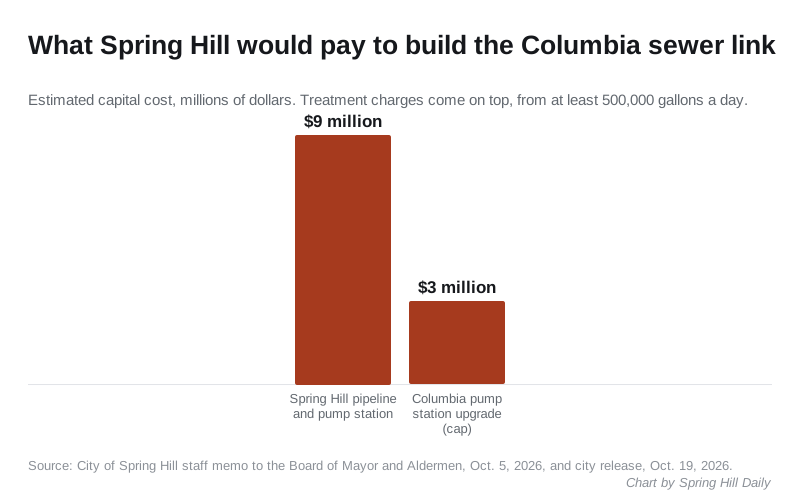
There is also a running cost. Once service starts, Spring Hill pays Columbia for at least 500,000 gallons a day, whether or not it sends that much. Flows above that, up to 1.5 million gallons, are billed by the gallon.
The rate is tied to Spring Hill’s own sewer volume charge per 1,000 gallons, the memo says. The memo adds that the capital costs and treatment charges “will require inclusion in the City’s capital planning, rate planning, and annual operating budgets.”
How long it lasts
The agreement runs for an initial 10 years, with two further 10-year terms, according to the staff memo. That makes 30 years in all.
Columbia has to finish the Carter’s Creek upgrade within 24 months of the agreement taking effect, or when its own treatment plant expansion is substantially complete, whichever is later. Only then can Spring Hill start sending wastewater.
Why Spring Hill needs it
Spring Hill is under a 2025 TDEC consent order that restricts new connections to the city’s sewer system. The city put a sewer moratorium in place to comply, according to Resolution 26-300 in the same packet.
The agreement says the Columbia link is part of Spring Hill’s “wastewater capacity management and treatment plant expansion strategy.” It would offset flows that the Spring Hill plant would otherwise treat. Neither the agreement nor the release says when, or whether, the moratorium would be eased as a result.
“The challenges facing our communities don’t stop at city limits, and neither should our willingness to work together,” Mayor Matt Fitterer said in the release.
Also this week: new water tank online
On the drinking water side, the city’s new Southside Water Tank is now in service, the city said in a separate release on Monday.
- It holds 2 million gallons.
- It sits just south of the Stonegate subdivision.
- Construction began in August 2025 and finished earlier this month.
- It brings the city’s total water storage to 12 million gallons.
What it means for you
- Nothing changes on your sewer bill or service today. The deal still needs state approval, and the pipe and the Columbia pump station upgrade have to be built first.
- The project is a cost the city says it will carry in future budgets and rate planning. Watch the Board of Mayor and Aldermen’s budget work for how it is funded.
- If you are building or planning a project that needs a new sewer connection, the moratorium rules still apply. Our building permits and zoning guide explains who to call at City Hall.
Have your say