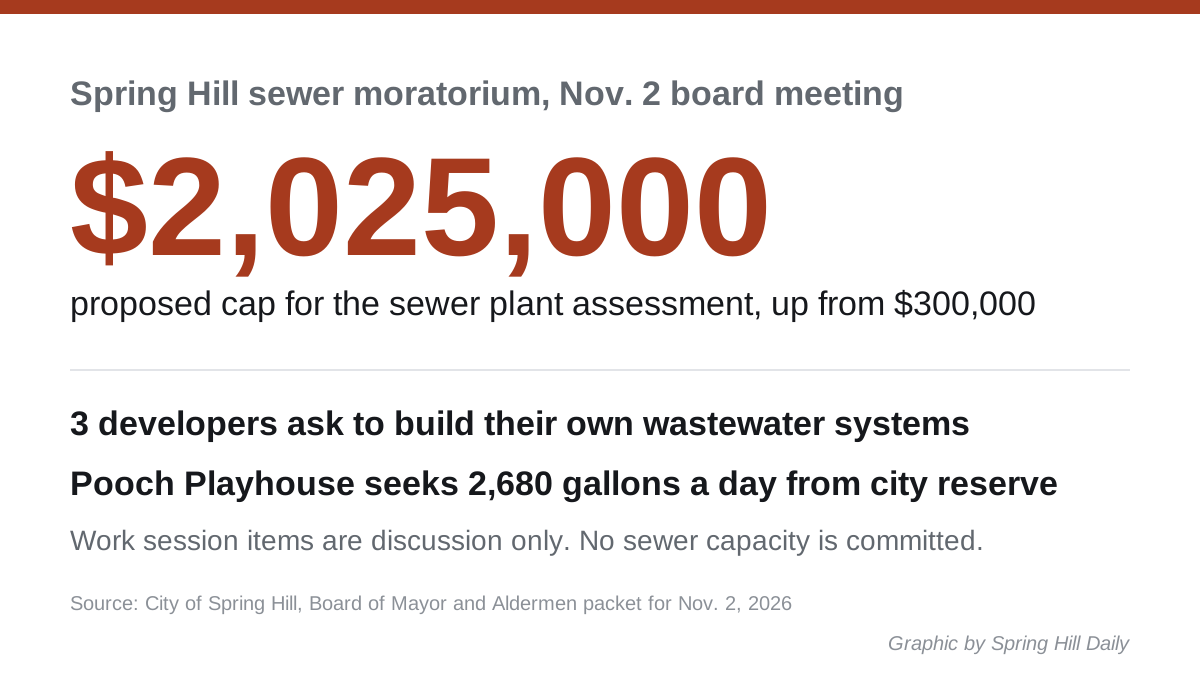
Aldermen vote Monday on another $400,000 for the sewer plant review the state ordered. Three developers ask to build their own wastewater systems.
Spring Hill’s review of its troubled sewer plant is set to cost up to $2,025,000. That is almost seven times the $300,000 the city first set aside last December.
The Board of Mayor and Aldermen votes Monday on Resolution 26-311. It would add $400,000 to the Reclamation Plant Assessment and Corrective Action Plan. The item is on the consent agenda, the list of items the board usually passes in one vote without debate, according to the agenda packet for the Nov. 2 meeting.
The same packet shows three developers asking the board to let them build their own wastewater systems while the city’s sewer moratorium stays in place. A fourth business is asking for a share of the city’s reserve of sewer capacity.
The board meets at 6 p.m. Monday in the boardroom at City Hall, 199 Town Center Parkway, the city calendar says.
Why the plant review keeps growing
The city is operating under a state consent order, TDEC Consent Order and Assessment WPC25-0093. The resolution says the order requires evaluations, corrective actions and long-term improvements at the Water Reclamation Facility. The city has hired several engineering firms to do that work.
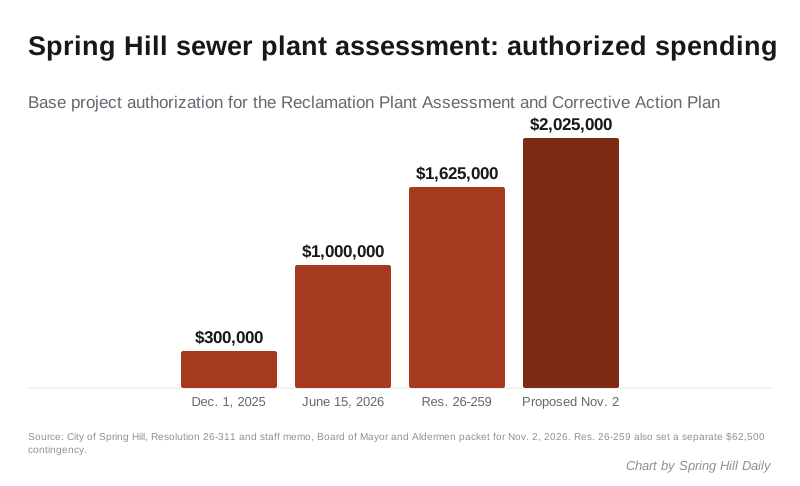
The $300,000 in December 2025 was “an initial planning estimate due to the unknown nature and extent of the evaluations required,” the resolution says. The board has raised it three times since then:
| When | Action | Base authorization |
|---|---|---|
| Dec. 1, 2025 | Resolution 25-281 creates the project | $300,000 |
| June 15, 2026 | Resolution 26-191 adds $700,000 | $1,000,000 |
| Later in 2026 | Resolution 26-259 adds $625,000, plus a separate $62,500 contingency | $1,625,000 |
| Monday, Nov. 2 (proposed) | Resolution 26-311 adds $400,000, no contingency | $2,025,000 |
A staff memo from Will Brasfield, assistant general manager of SPARTAN, and City Administrator Carter Napier says more money is needed “as the project continues to progress and additional information regarding the condition and needs of the Water Reclamation Facility becomes available.” It does not say what the engineers have found so far. The money would come from account 410-52428-59121.
Three projects want their own systems
The board will discuss the three requests in its work session. Staff recommend in each case that the board let them prepare a resolution, so the developer can move on to a more detailed design. No vote on the systems themselves is scheduled Monday. The staff memos list:
- 3523 and 3545 Mahlon Moore Road. About 23.68 acres, now zoned agricultural. The applicant wants to rezone to R-2 and build 32 single-family homes on public streets, served by a Bioclere treatment system. The engineer’s analysis puts the most the site’s soils can take at 9,680 gallons a day. The project would still need a rezoning and plat approval.
- 3521 Cleburne Road (SHIP West). About 38.86 acres zoned light industrial. The concept plan shows a warehouse of about 488,232 square feet with truck docks and parking. It would need a site plan change.
- Miles Johnson Parkway (Keystone Outdoors). Four parcels totaling about 10.7 acres at the southeast corner of Main Street and Miles Johnson Parkway, zoned general commercial. Keystone Outdoors plans a 51,000-square-foot showroom, office and shop for outdoor living products, with a private septic system designed for 450 gallons a day. It would need a special use permit and site plan.
The developers would pay to design, permit, install and maintain the systems. But staff warn that the city would lose “predictable, recurring monthly sewer utility fees” if the systems kept running once the city has capacity again. The Mahlon Moore and Keystone memos say the systems should not be designed to run forever. The Keystone memo says the property should connect to city sewer when capacity is available.
Staff also noted that the Keystone concept plan “does not appear to show the drain field.”
A dog daycare asks for reserve capacity
Pooch Playhouse wants to expand its building at 1001 Parkway Drive. Its engineer, M2 Group, projects growth from five to 15 employees, one to three grooming stations and 20 to 90 kennels.
That would raise its wastewater from an estimated 965 gallons a day to 3,645, a net increase of 2,680. The business is asking for that amount from the city’s 100,000-gallon-a-day reserve for future discretionary allocations, set up under the moratorium ordinance, Ordinance 25-29.
The staff memo says M2 Group took its flow figures from Vermont’s state wastewater rules. They are not Spring Hill or TDEC design standards, but they “provide a consistent method” for comparing the old and new use of the building, the memo says.
About 99,040 gallons a day were left in the reserve after an earlier allocation to Nelly’s, according to the memo. Granting Pooch Playhouse’s request would leave about 96,360. Staff recommend that the board direct them to draw up a formal agreement. Nothing is committed Monday.
Also on Monday’s agenda
- Addressing manual. Resolution 26-307 would adopt the Spring Hill Addressing Manual, the city’s standards for naming streets and subdivisions and numbering addresses.
- Water plant equipment. Resolution 26-308 would award the bid for clarifier and filter equipment at the water treatment plant to Tencarva Machinery Company.
- Stormwater projects. Resolution 26-306 releases the final retainage to Jarrett Builders. The memo says all four stormwater drainage projects are complete.
- Brush grinding. Resolution 26-309 renews the brush grinding and debris removal contract with Benchmark Companies.
- New homes in June Lake. Two development agreements with Signature Homes, for Windfall Phase 1 and POD E Section 3, which has 75 lots.
- Work session. The city’s strategic plan, a request to lay final asphalt at Legacy Pointe before it is 80% built, a change to the construction traffic code, an update on 2024 bond spending and a change to the city’s Rippavilla management agreement with The Battle of Franklin Trust.
What it means for you
- If you are planning a project that needs a new sewer connection, the moratorium still applies. The on-site systems on Monday’s agenda are case-by-case requests, not a new route open to everyone.
- The packet does not say whether the cost of the plant review will affect sewer rates.
- You can speak at the start or end of Monday’s meeting during citizen comments. The full packet is on the city’s Agenda Center.
- The deal to send some of Spring Hill’s wastewater to Columbia is still waiting on state approval. Read our story on the $12 million sewer link to Columbia.
Have your say