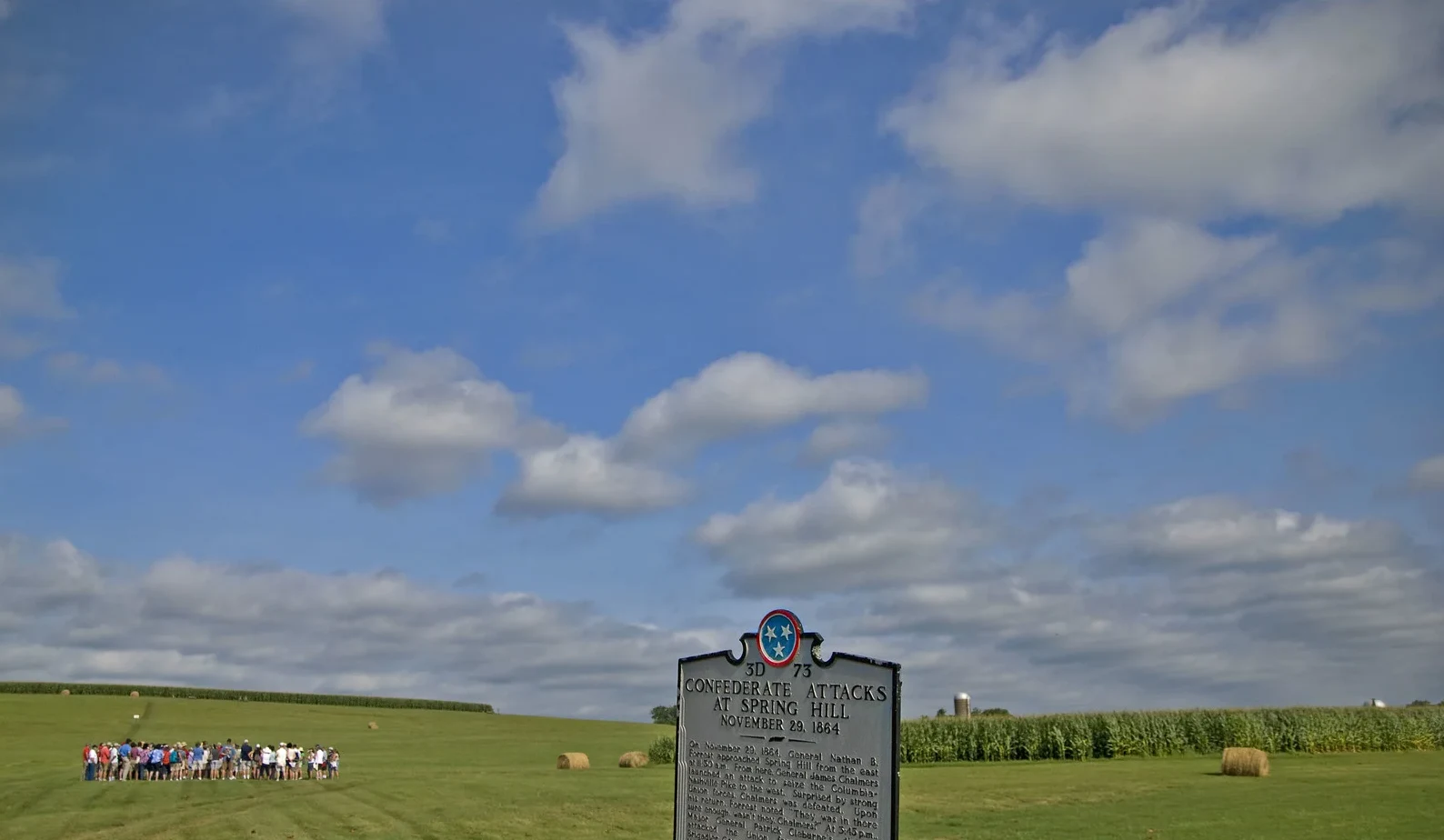
Spring Hill was incorporated in 1837 and saw the Battle of Spring Hill on Nov. 29, 1864. Its National Register listings, Rippa Villa and the battlefield.
Last checked Oct. 19, 2026. Sources: the city’s City History, Battle of Spring Hill and Historically Significant Properties pages, the University of Tennessee’s Municipal Technical Advisory Service, the National Park Service’s National Register of Historic Places data and the American Battlefield Trust.
Spring Hill grew from a farming settlement into a city of more than 60,000 people. Its history is in three layers: the antebellum homes and churches along Main Street, the Civil War night of Nov. 29, 1864, and the Saturn plant that turned a small town into a city in the 1980s.
Visit
- Rippa Villa: 5700 Main St., 931-486-9037, 9 a.m. to 5 p.m. Monday to Saturday and 10 a.m. to 5 p.m. Sunday; last guided tour at 4 p.m.; closed New Year’s Day, Easter, Thanksgiving, Christmas Eve and Christmas Day (Battle of Franklin Trust)
- Spring Hill battlefield trail: Kedron Road at Reserve Boulevard
- Spring Hill Historic Commission: 6 p.m. first Thursday of even months, City Hall, 199 Town Center Parkway
Founding and incorporation
The Cherokee, Chickasaw and Shawnee hunted the rolling, spring-fed land before settlers arrived with land grants, the city’s history page says. Spring Hill was incorporated on Dec. 26, 1837, by Private Acts 1837-38, chapter 307, according to the state’s Municipal Technical Advisory Service. It has run under Tennessee’s general-law mayor-aldermanic charter since 1987. The railroad later gave the town an early link to Nashville.
The Battle of Spring Hill, Nov. 29, 1864
On the night of Nov. 28, 1864, Gen. John Bell Hood’s Confederate Army of Tennessee marched toward Spring Hill to get astride the supply line of Maj. Gen. John M. Schofield’s Union army, the city’s battle page says. On Nov. 29, Hood’s infantry crossed the Duck River and converged on Spring Hill, where Schofield had reinforced the crossroads. In late afternoon the Union troops turned back a piecemeal Confederate attack, and during the night the rest of Schofield’s army passed through Spring Hill to Franklin. It was, the city says, perhaps Hood’s best chance to isolate and defeat the Union army, and the episode led directly to the Battle of Franklin.
The American Battlefield Trust has preserved more than 195 acres of the battlefield, with an interpretive walking trail on Kedron Road at Reserve Boulevard (Trust page). The city recognized the battlefield as a historically significant site on Feb. 16, 2010.
Rippa Villa
Rippa Villa, built in the 1850s for the Cheairs family, served as headquarters for generals of both armies during the war. In May 2017 the City of Spring Hill accepted the donation of the house and 98.4 acres of park land, with a carriage house, an original slave cabin, a Freedmen’s Bureau schoolhouse, the Cheairs Cemetery and Brown’s Stand, according to the city. The house was listed on the National Register as Rippavilla in 1996. Tours are run by the Battle of Franklin Trust.
National Register of Historic Places
National Park Service records list these properties with a Spring Hill address, with the year each was listed:
| Property | Location | Listed |
|---|---|---|
| Grace Episcopal Church | 5291 Main St. | 1976 |
| Ewell Farm | Depot Lane | 1976 |
| Martin Cheairs House (Ferguson Hall) | US 31 | 1976 |
| Ritter-Morton House | 412 McLemore Ave. | 1976 |
| White Hall | Duplex Road | 1984 |
| Spring Hill Presbyterian Church | South Main Street | 1984 |
| Rippavilla | US 31, south of Kedron Road | 1996 |
| St. Mark United Primitive Baptist Church | Maury Hill Street | 2000 |
| Haynes Haven Stock Farm | US 31 between Northfield and Denning lanes | 2023 |
| Old Stone Creamery | 2301 Sugar Ridge Road | 2025 |
Listed in the countryside around the city (National Register “vicinity” listings): the Absalom Thompson House, south of Spring Hill on Denning Road (1979); the Derryberry House, New Lasea Road east of I-65 (1990); Maplewood Farm, 3085 Duplex Road, in Williamson County (boundary increase, 1993); and Cleburne Jersey Farm, 2319 Sugar Ridge Road (2000).
Spring Hill’s own historic list
Since 2007 the city’s Historic Commission has recognized 30 historically significant properties, among them Oaklawn on Denning Lane, the Old Spring Hill Cemetery, Mt. Hope Baptist Church, the Old City Hall and Fire Station, the Old Kedron Pike Bridge over McCutcheon Creek, Dalton’s Store and NewTown Cemetery. Each has a write-up on the city’s site.
The Saturn era
The city’s history dates the change to 1980, when industry, and the arrival of General Motors’ Saturn plant, turned a mainly agricultural town into a manufacturing city, and newcomers arrived in great numbers. The population went from 7,715 in 2000 to 29,036 in 2010 and 50,005 in 2020; see our population guide.
Related guides: parks and trails, things to do this month, moving to Spring Hill and a guide to Rippa Villa.
Frequently asked questions
When was Spring Hill, Tennessee, founded?
Spring Hill was incorporated on Dec. 26, 1837, by a private act of the Tennessee General Assembly, according to the University of Tennessee’s Municipal Technical Advisory Service.
What happened at the Battle of Spring Hill?
On Nov. 29, 1864, Gen. John Bell Hood’s Confederate army tried to cut off Maj. Gen. John Schofield’s Union army at Spring Hill. A piecemeal Confederate attack failed, and that night Schofield’s army marched through to Franklin, setting up the Battle of Franklin the next day.
Can you tour Rippa Villa in Spring Hill?
Yes. Rippa Villa, 5700 Main St., is run by the Battle of Franklin Trust, open 9 a.m. to 5 p.m. Monday to Saturday and 10 a.m. to 5 p.m. Sunday, with the last guided tour at 4 p.m. Call 931-486-9037.
What National Register sites are in Spring Hill?
Ten listings carry a Spring Hill address, including Grace Episcopal Church, Ewell Farm, the Martin Cheairs House, Rippavilla, White Hall and Spring Hill Presbyterian Church, plus four more in the surrounding countryside.
Have your say